
Quick answer
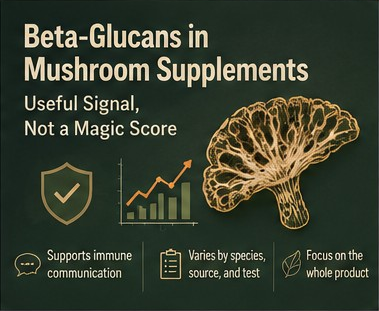
Beta-glucans are among the most discussed compounds on mushroom supplement labels. A measured percentage can improve transparency, but it should be treated as one composition metric—not a universal potency score or promise of a health result.
Key takeaways
- Beta-glucans are polysaccharides found in fungal cell walls.
- The percentage, serving size, assay, and species all affect interpretation.
- High starch or alpha-glucans may signal grain or other carbohydrate material.
- Beta-glucan disclosure does not replace identity, contaminant, and microbiological testing.
- A laboratory number is not the same as clinical evidence for a finished product.
What beta-glucans are
Beta-glucans are glucose polymers whose linkage patterns and physical properties vary across fungi, yeast, oats, and barley. Mushroom beta-glucans commonly include beta-1,3 backbones with beta-1,6 branching, but branching, solubility, molecular size, extraction, and source can differ. That means “beta-glucan” is not one uniform molecule and a single percentage cannot summarize every biological property of a mushroom ingredient.
Why labels use a percentage
A measured percentage can show how much of a tested sample was reported as beta-glucans. It is most useful when the company identifies the ingredient tested, the laboratory, the method, the lot, and the date. Percentages alone can mislead because they do not show the absolute amount consumed. Twenty percent of a 500 mg serving provides a different approximate amount than twenty percent of a 2,000 mg serving.
How to estimate beta-glucans per serving
When the label gives both the tested percentage and the weight of that exact ingredient per serving, multiply the ingredient weight by the decimal percentage. For example, 1,000 mg of an ingredient reported at 25% beta-glucans would represent an estimated 250 mg in that tested material. This remains an estimate: the consumer product may vary by lot, the number may apply to a raw ingredient rather than the finished blend, and the test method and moisture basis matter.
The alpha-glucan and starch question
Mushroom mycelium is often grown on grain, and residual grain can contribute starch or alpha-glucans. Some laboratories report alpha-glucans alongside beta-glucans to help interpret the sample. A high “polysaccharide” number without a specific beta-glucan result can include starch and other carbohydrates, making it difficult to compare with a product that reports beta-glucans directly. The useful question is not whether any alpha-glucan exists, but whether the composition is transparent and appropriate for the labeled ingredient.
Why more is not automatically better
Different species contain compounds that are not captured by a beta-glucan score. Reishi triterpenes, Lion’s Mane-related diterpenoids, and Cordyceps nucleosides are examples of other research interests. A concentrated beta-glucan ingredient may be appropriate for one purpose while a different standardized extract is used in another study. Beta-glucans can be a quality and identity clue, but they are not a universal potency ranking across every mushroom species and product goal.
What a useful certificate of analysis includes
Ask for a recent certificate tied to a finished-product lot or to the exact mushroom ingredient used in the product. Useful fields include identity, beta- and alpha-glucans, heavy metals, microbial limits, pesticides where relevant, solvents where relevant, and laboratory details. Check whether the product name or lot matches what you are buying. A generic marketing PDF with no lot, date, method, or laboratory provides less assurance than a current document connected to the product.
How to use the number in a buying decision
Use beta-glucan information to compare transparency within similar products, not to convert every purchase into a contest for the highest percentage. First compare species and format. Then compare the amount of mushroom ingredient per serving, the beta-glucan result and method, the presence of other active ingredients, and the product’s warnings and testing. If a company makes the number prominent but cannot explain what was tested, treat that gap as part of the decision.
Frequently asked questions
Is 30% beta-glucans good?
It can be a useful composition figure, but “good” depends on serving size, species, assay, other quality tests, and the intended product.
Are beta-glucans the active ingredient in every mushroom?
No. They are important fungal compounds, but other constituents may be relevant depending on species and research question.
Can I trust “polysaccharides” on a label?
The term can include starch and other carbohydrates. A specific validated beta-glucan test is more informative.
Sources and further reading
Reviewed and organized by the MyShroom Planet™ Editorial Team. Product labels, formulas, and retailer listings can change, so use the current package directions for the exact product you purchase.