Quick answer
Functional mushrooms are species sold for more than culinary flavor, usually as capsules, powders, coffee blends, gummies, or liquid extracts. The useful question is not whether mushrooms are “powerful.” It is what species, material, preparation, dose, and evidence a particular product actually contains.
Key takeaways
- “Functional” is a marketing category, not a regulated promise of effectiveness.
- A species name does not tell you the part used, extraction method, concentration, or dose.
- Coffee, gummies, capsules, drops, and powders solve different routine problems.
- Single-ingredient products are easier to evaluate; blends can be convenient but harder to troubleshoot.
- Health claims should remain within evidence and supplement-law boundaries.
What “functional mushroom” actually means
“Functional mushroom” is a market category, not a single scientific or regulatory class. It usually refers to mushroom species sold for a purpose beyond flavor, such as Lion’s Mane, Reishi, Cordyceps, Turkey Tail, Chaga, Maitake, Shiitake, or Tremella. The term does not establish that a product is effective, that every species has the same evidence, or that a multi-mushroom blend contains a meaningful amount of each ingredient. Start with the exact species, the fungal material, the preparation, the dose, and the evidence connected to that preparation.
The species shoppers see most often
Lion’s Mane is commonly marketed around cognition; Reishi around relaxation or immune support; Cordyceps around exercise or energy; Turkey Tail around immune-related research; and Chaga, Maitake, Shiitake, and Tremella around broader wellness themes. Those marketing lanes often flatten important differences. A trial using a standardized extract in a defined population is not interchangeable with a gummy, coffee blend, culinary powder, or proprietary mix carrying the same species name. Ten mushrooms on the front label may simply mean ten ingredients share one total blend amount.
Format changes both adherence and formulation
Coffee anchors an existing morning habit but may add caffeine, coffee solids, creamers, flavors, or MCT oil. Gummies reduce pill friction but may add sugar, sugar alcohols, acids, colors, and a larger number of units per serving. Capsules provide a fixed serving but can contain multiple pills and excipients. Powders allow flexible use but require measuring and can be easy to under- or over-serve. Liquid extracts avoid pills but require review of the carrier, concentration, dropper instructions, and alcohol or glycerin content. The “best” format is the one whose complete formula and routine you can evaluate and consistently use.
Fruiting body, mycelium, and extracts
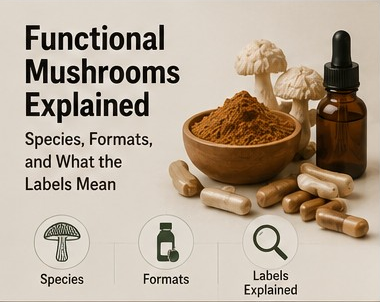
The fungal material matters, but labels need more nuance than “fruiting body good, mycelium bad.” Research may use fruiting bodies, cultured mycelium, fermentation products, or isolated compounds depending on the species and question. The practical concern is transparency: does the label identify the species and material, and does a mycelium product include substantial residual grain or substrate? Extract language also needs context. A 10:1 or 14:1 ratio describes input-to-output relationships claimed by the manufacturer; it does not independently prove composition, potency, or clinical equivalence.
Evidence is product- and preparation-specific
Human evidence varies sharply by species, outcome, dose, duration, and participant group. Laboratory and animal studies can explain possible mechanisms, but they do not establish that a retail product will create a noticeable result in a particular person. Even when a species has promising human research, the study product may differ from the listing in extraction method, standardization, dose, and additional ingredients. Strong buying language therefore separates “the species has been studied” from “this exact product has been clinically tested.”
Safety belongs inside the product decision
Mushroom supplements can still cause unwanted effects, allergies, digestive symptoms, or interactions. Added ingredients such as caffeine, Ginkgo, Bacopa, Ashwagandha, black pepper extract, vitamins, or MCT oil can matter as much as the mushroom. Pregnancy, breastfeeding, surgery, immune conditions, bleeding risk, medication use, and mushroom allergy are reasons to involve a qualified clinician or pharmacist. A supplement should not be used to replace evaluation or treatment for fatigue, memory changes, depression, anxiety, ADHD, or another medical concern.
A practical way to choose
Build the decision backward from the routine. First identify the option you will use. Second choose one clear goal for the experiment. Third select the simplest formula that fits that goal. Fourth record the serving, caffeine, other actives, and start date so you can judge tolerance without stacking several new products at once. Finally, verify the current seller, label, warnings, and return or subscription terms. This approach is less exciting than buying the bottle with the loudest mushroom count. It is also far more useful.
Frequently asked questions
Are functional mushrooms psychedelic?
No. Common functional mushroom supplements such as Lion’s Mane, Reishi, and Cordyceps are not psychedelic mushrooms.
Is a blend better than one mushroom?
Not automatically. Blends offer convenience; single-ingredient products make dose and response easier to evaluate.
Which format absorbs best?
A format claim alone is not enough. Extraction, ingredients, dose, and the specific compound matter more than broad “fast absorption” language.
Sources and further reading
Reviewed and organized by the MyShroom Planet™ Editorial Team. Product labels, formulas, and retailer listings can change, so use the current package directions for the exact product you purchase.