Quick answer
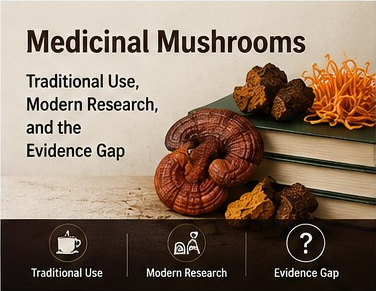
“Medicinal mushroom” is a marketplace phrase, not a guarantee that a mushroom product treats disease. Species such as Lion’s Mane, Reishi, Turkey Tail, Cordyceps, Chaga, Maitake, and Shiitake have long histories of food or traditional use and are now studied for polysaccharides, beta-glucans, terpenoids, sterols, phenolic compounds, and other constituents. The research ranges from laboratory experiments to human trials, but evidence quality, preparation, dose, species, and outcomes vary widely.
Key takeaways
- Traditional use can guide research but does not replace clinical evidence.
- Species, strain, fungal material, extraction method, dose, and testing all affect what is in a product.
- Beta-glucan percentages can be useful label information but do not prove a health outcome.
- Dietary supplements cannot legally be marketed as cures or treatments for diseases without appropriate authorization.
- Medication interactions, allergies, pregnancy, surgery, autoimmune conditions, and product contamination deserve real attention.
Why the term needs precision
A whole culinary mushroom, hot-water extract, alcohol extract, dual extract, fermented mycelium, myceliated grain product, and isolated compound are not interchangeable. Even products with the same species name may differ sharply in concentration and composition.
When a study uses a defined extract, its findings cannot automatically be transferred to every capsule, gummy, coffee, or tincture on the market.
What researchers study
Lion’s Mane research often examines compounds associated with the fruiting body or mycelium and possible effects on neurological pathways. Reishi research explores triterpenes, polysaccharides, and immune-related mechanisms. Turkey Tail products have been studied in adjunctive oncology contexts in some countries, while Cordyceps-related research explores exercise, metabolism, and other pathways.
These research areas are not permission to claim that retail supplements prevent dementia, treat cancer, cure depression, reverse fatigue, or replace medical care.
Understanding beta-glucans
Beta-glucans are structural polysaccharides found in fungal cell walls. Laboratories can measure them, and a disclosed percentage may help shoppers compare label transparency. But “more” is not automatically “better” for every product, and the assay, serving size, species, extraction, and intended use still matter.
Starch testing can also be relevant because grain-based material may raise alpha-glucan or starch content. Ask what was tested, by whom, and whether a certificate of analysis is available.
Fruiting body, mycelium, and substrate
Fruiting bodies and mycelium can contain different compounds. Mycelium is not inherently fraudulent, and fruiting body is not automatically superior for every research question. The practical issue is whether the label accurately identifies the material and whether grain or substrate is included in the finished product.
Transparent products state the species, part used, extraction method, serving size, other ingredients, and testing standards without forcing shoppers to decode a mystery blend.
Safety is part of product quality
Mushrooms can trigger allergic reactions. Extracts may interact with medications or affect bleeding, blood sugar, blood pressure, immune activity, or digestion depending on the ingredient and person. Contamination, species misidentification, heavy metals, microbes, and adulteration are additional quality concerns.
People who are pregnant, breastfeeding, preparing for surgery, managing a medical condition, or taking medications should discuss supplement use with a qualified clinician or pharmacist.
A responsible way to shop
Start with the exact goal and preferred format. Then compare the species, ingredient list, dose, extract details, testing, warnings, seller, and cost per serving. Avoid products that rely on disease language, impossible certainty, hidden proprietary blends, or testimonials presented as proof.
The best label is the one you can understand well enough to explain what you are buying—and what it has not been proven to do.
Frequently asked questions
Are medicinal mushrooms FDA approved?
Dietary supplements are not approved by the FDA for effectiveness before sale in the same way prescription drugs are. Products must still follow applicable labeling and manufacturing laws.
Do beta-glucans prove a mushroom supplement works?
No. They can provide composition information, but they do not by themselves establish a clinical outcome.
Is fruiting body always better than mycelium?
No universal rule fits every species, compound, or research question. Accurate labeling and evidence for the specific preparation matter.
Can mushroom supplements replace medical treatment?
No. They should not be used to diagnose, treat, cure, or prevent disease or replace professional care.
Sources and further reading
Reviewed and organized by the MyShroom Planet™ Editorial Team. Product labels, formulas, and retailer listings can change, so use the current package directions for the exact product you purchase.