
Quick answer
“Natural” does not mean interaction-free. Mushroom supplements can combine concentrated extracts with herbs, vitamins, caffeine, sweeteners, and absorption enhancers. The safety question belongs at the beginning of the purchase—not in tiny text after checkout.
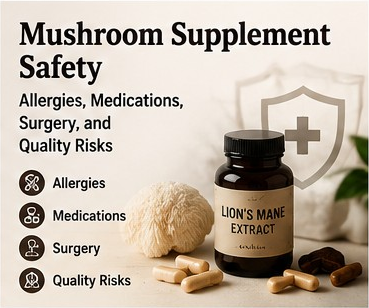
Key takeaways
- Mushroom allergies can occur.
- Multi-ingredient products create more interaction and side-effect variables.
- Pregnancy, breastfeeding, surgery, autoimmune conditions, and medications warrant professional review.
- Quality risks include contamination, adulteration, species errors, and inaccurate labels.
- Supplements should not replace diagnosis or treatment.
Supplements are not substitutes for evaluation
Fatigue, memory change, weakness, mood symptoms, sleep problems, or digestive symptoms can have medical causes. A mushroom supplement should not delay diagnosis or replace treatment. Disease language such as “cures,” “treats,” “prevents,” or “reverses” is a warning sign on an ordinary supplement listing. Structure-and-function wording is still not a guarantee that the product will create a noticeable outcome.
Review the entire formula
The mushroom may not be the ingredient most relevant to safety. Products can include caffeine, Ginkgo, Bacopa, Ashwagandha, L-theanine, vitamins, black pepper extract, MCT oil, sweeteners, herbs, or multiple mushrooms. Compare the formula with prescriptions, over-the-counter medicines, beverages, and other supplements. Pepper extract, for example, is often included to affect absorption, which makes medication review more—not less—important.
Know when to ask a clinician or pharmacist
Get professional guidance when pregnant or breastfeeding, preparing for surgery, giving a product to a child, using anticoagulants or antiplatelet drugs, taking immunosuppressive medicine, managing autoimmune or chronic conditions, or using multiple medications. A pharmacist can often identify interaction and duplication concerns. Bring the actual label or a clear photograph rather than only the product name.
Allergy and digestive reactions
People allergic to mushrooms or molds may need extra caution, although an allergy to one organism does not perfectly predict every product. Possible unwanted effects can include digestive discomfort, nausea, diarrhea, rash, itching, headache, or other symptoms depending on the product and added ingredients. Stop using a product and seek appropriate care for signs of a serious allergic reaction, severe symptoms, or rapidly worsening symptoms.
Start one change at a time
Stacking a new mushroom coffee, gummy, capsule blend, and energy product on the same day makes it difficult to identify what helped or caused a problem. Introduce one product, follow the labeled serving, and record the start date, time, food, caffeine, and symptoms. Do not exceed the serving because an effect is not immediately noticeable. Supplements are not rescue medications.
Quality and seller checks
Buy from a seller and brand you can identify. Verify seals, lot numbers, expiration, manufacturer or distributor details, storage, and a way to report a problem. Look for testing that addresses identity and contaminants, not just a generic “third-party tested” badge. Marketplace listings can change sellers or variations, so check the current page each time rather than assuming a previous purchase is identical.
Report serious problems
In the United States, serious adverse events associated with dietary supplements can be reported to the FDA through the Safety Reporting Portal or MedWatch pathways. Keep the package, lot number, purchase record, serving used, timing, other products, and medical documentation. Reporting does not prove causation, but it gives regulators and manufacturers information needed to identify patterns.
A safer decision rule
Choose the simplest formula that fits the purpose, avoid disease claims, verify the current label, check interactions, and stop when the product creates concerning symptoms. “Natural” does not mean interaction-free, and “traditional” does not establish that a concentrated modern extract is appropriate for every person. Good supplement content should make caution easier, not bury it beneath a buy button.
Frequently asked questions
Can I take Lion’s Mane with medication?
That depends on the medication, dose, product, and health history. Ask a clinician or pharmacist with the exact label in hand.
Are mushroom supplements safe before surgery?
Do not assume so. Tell the surgical team about every supplement and follow their stop-date instructions.
Who regulates dietary supplements?
In the United States, the FDA regulates dietary supplements under a framework different from drugs. Manufacturers are responsible for lawful, truthful labeling and product safety.
Sources and further reading
Reviewed and organized by the MyShroom Planet™ Editorial Team. Product labels, formulas, and retailer listings can change, so use the current package directions for the exact product you purchase.