
Quick answer
Fungi can digest complex organic material, tolerate harsh environments, produce powerful enzymes, and bind certain contaminants to their cell walls. Those abilities make them interesting tools for bioremediation—the use of living organisms or biological processes to reduce environmental contamination. When fungi are central to the strategy, the term mycoremediation is often used. The science is promising, but “fungi can clean pollution” is not a complete treatment plan.
Key takeaways
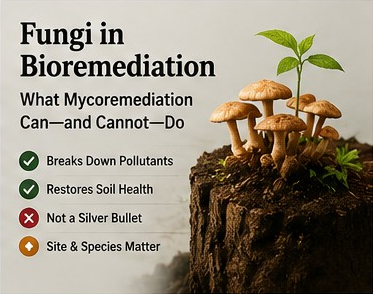
- Mycoremediation is a family of approaches, not one universal technique.
- Fungal enzymes may transform some organic pollutants, while fungal biomass may bind or concentrate some metals.
- Laboratory success does not automatically translate to contaminated soil, sediment, or groundwater.
- Site chemistry, competing organisms, temperature, moisture, oxygen, and contaminant bioavailability all affect performance.
- A responsible project requires contaminant testing, treatment goals, monitoring, and safe management of residual biomass.
How fungi interact with contaminants
White-rot and other wood-decay fungi produce extracellular enzymes capable of breaking difficult plant polymers. Some of those enzymes are chemically broad enough to act on certain dyes, hydrocarbons, pesticides, pharmaceuticals, and other organic compounds under experimental conditions.
For metals and metalloids, fungi cannot destroy the element. They may adsorb it to cell walls, accumulate it in biomass, change its chemical form, or influence how mobile it is. That means the final handling of contaminated fungal material can be as important as the growth stage.
Why laboratory studies look easier
A laboratory can control pH, temperature, nutrients, moisture, contaminant concentration, and the competing microbial community. A polluted site cannot. Soil particles may bind a contaminant so tightly that fungal enzymes cannot reach it. Native microbes may outcompete the introduced strain. Weather and oxygen can shift quickly.
A treatment that reduces a chemical in a flask may be slower, inconsistent, or ineffective in the field. Pilot testing is therefore not a bureaucratic extra; it is how researchers discover whether the mechanism survives reality.
Common mycoremediation approaches
Researchers may add fungal cultures to contaminated material, stimulate fungi already present, apply isolated enzymes, use spent mushroom substrate, or combine fungal treatment with plants, bacteria, composting, filtration, or physical removal.
The best approach depends on the pollutant and the cleanup goal. Destroying an organic compound, reducing toxicity, preventing migration, and removing contaminated biomass are different outcomes and require different measurements.
What success should actually measure
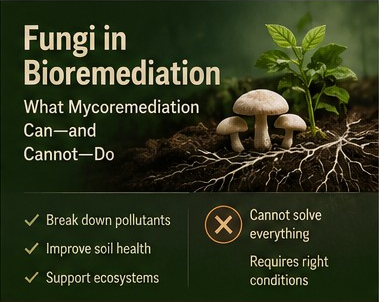
Disappearance of the original compound is not enough if it becomes a harmful intermediate. Strong studies measure parent compounds, breakdown products, toxicity, bioavailability, and sometimes ecological recovery.
For metal-binding projects, success also requires a plan for harvesting, transporting, treating, or disposing of the loaded biomass. Otherwise contamination may simply move from soil into mushrooms or mycelium.
Where the field is most useful
Mycoremediation may be valuable as a lower-energy treatment step, a pre-treatment, a polishing stage, or part of an integrated remediation system. It may also provide useful routes for treating certain industrial waste streams under controlled conditions.
The most credible opportunity is not a fungus that “eats everything.” It is a well-matched organism or enzyme, a defined contaminant, known site conditions, measurable endpoints, and a safe residuals plan.
Do not attempt cleanup by growing edible mushrooms
Mushrooms grown on contaminated material should not be treated as food. Some species can accumulate metals or other compounds. Environmental cleanup work should be designed with qualified environmental professionals and appropriate testing, permits, worker protection, and waste handling.
Frequently asked questions
Can fungi destroy heavy metals?
No. Elements cannot be biologically destroyed. Fungi may bind, accumulate, mobilize, or change the chemical form of metals.
Does mycoremediation work on oil?
Some fungi and fungal enzymes can act on certain petroleum hydrocarbons under suitable conditions, but site-specific testing is essential.
Can spent mushroom substrate be used in remediation?
It is being studied and used in some contexts because it can contain fungal biomass, enzymes, and organic material. Performance and residual handling must be evaluated.
Is mycoremediation ready for every contaminated site?
No. It is promising for selected contaminants and conditions, often as part of a combined treatment system.
Sources and further reading
Reviewed and organized by the MyShroom Planet™ Editorial Team. Product labels, formulas, and retailer listings can change, so use the current package directions for the exact product you purchase.