Quick answer
Mycology is the study of fungi: mushrooms, molds, yeasts, rusts, smuts, and countless microscopic species that rarely make the spotlight. Fungi are not plants. They form their own kingdom and use a fundamentally different strategy for living: they digest food outside their bodies and absorb the resulting nutrients. Once you understand that single fact, forests, fermentation, decomposition, plant disease, medicine, and mushroom cultivation start fitting together.
Key takeaways
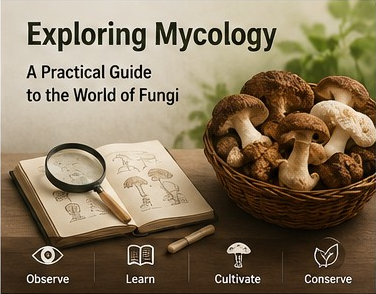
- Fungi are a distinct kingdom, not unusual plants.
- The visible mushroom is usually only the reproductive structure of a much larger fungal organism.
- Mycelium, hyphae, spores, fruiting bodies, and ecological roles are the core vocabulary.
- Mycology connects ecology, food, medicine, agriculture, materials science, and environmental cleanup.
- Responsible identification requires more than comparing a photograph.
Fungi are not plants
Plants generally make energy through photosynthesis. Fungi do not contain chlorophyll and cannot manufacture food from sunlight. Instead, fungal threads release enzymes into wood, soil, food, or living tissue, break complex material into smaller molecules, and absorb those nutrients.
Fungal cell walls also differ from plant cell walls. Chitin—a structural material also found in arthropod exoskeletons—is a defining component of many fungal cell walls. These distinctions are why modern biology places fungi in their own kingdom.
How fungi obtain food
Saprotrophic fungi decompose dead organic material. Parasitic fungi obtain nutrients from living hosts and may cause disease. Mutualistic fungi exchange resources with another organism in a relationship that benefits both partners. Mycorrhizal fungi, for example, associate with plant roots and can trade mineral nutrients and water for plant-produced carbon.
These categories explain why one species fruits on a dead log, another appears near a particular tree, and another is difficult to cultivate away from its host relationship.
How fungi reproduce
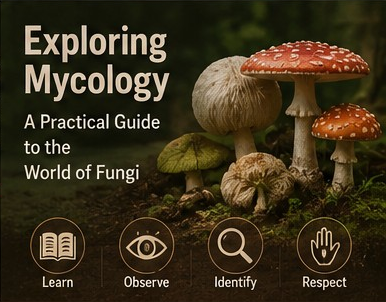
Many fungi reproduce through spores. Spores can be produced sexually or asexually and dispersed by wind, water, animals, or physical disturbance. A mushroom’s cap, pores, gills, teeth, folds, or other fertile surface helps produce and release them.
Spore color, microscopic structures, bruising reactions, habitat, season, odor, and substrate can all matter in identification. A single photo is rarely enough for a high-confidence edible identification.
Why mycology matters now
Fungi help recycle nutrients, form plant partnerships, ferment foods, produce medicines, create industrial enzymes, and inspire new materials. Researchers also study fungal pathways for bioremediation, sustainable packaging, food proteins, dyes, and other applications.
The field is expanding because fungi are both ecologically essential and chemically inventive. The useful move is not to call every fungus miraculous; it is to ask what species, strain, process, evidence, and real-world conditions are involved.
How to begin learning mycology
Start with basic fungal anatomy, then observe habitat and substrate. Photograph the cap, underside, stem, base, surrounding trees, and the material from which the mushroom grows. Record location, date, weather, odor, color changes, and spore print when appropriate.
Use multiple regional references and experienced local identifiers. Never eat a wild mushroom solely because an app, image search, social post, or one online article suggests a match.
Frequently asked questions
What is the difference between a fungus and a mushroom?
A fungus is the organism. A mushroom is one possible fruiting structure produced by certain fungi.
Is mycelium the root of a mushroom?
“Root” is a convenient analogy, but mycelium is not a plant root. It is a network of fungal hyphae that digests and absorbs nutrients.
Are all fungi mushrooms?
No. Yeasts, molds, rusts, and many microscopic fungi never form the familiar cap-and-stem mushroom.
Can a phone app safely identify edible mushrooms?
No tool should be the sole basis for eating a wild mushroom. Identification should use multiple characteristics and qualified local expertise.
Sources and further reading
Reviewed and organized by the MyShroom Planet™ Editorial Team. Product labels, formulas, and retailer listings can change, so use the current package directions for the exact product you purchase.