Quick answer
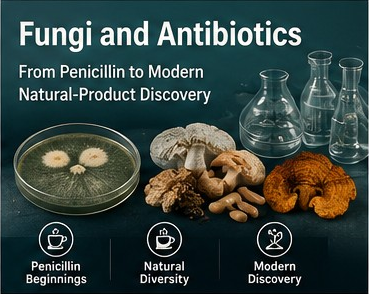
The history of antibiotics is inseparable from fungi. Penicillin emerged from observations of a Penicillium mold, and fungal chemistry later supplied other medically important compounds. But accurate science requires a crucial correction: many famous antibiotics come from bacteria—especially Streptomyces—not fungi. Fungi remain a major source of bioactive molecules, yet the story is about careful screening, fermentation, purification, testing, and drug development, not simply harvesting a mushroom.
Key takeaways
- Penicillin is a fungal natural product associated with Penicillium molds.
- Streptomyces, the source of many antibiotics, is a bacterial genus—not a fungus.
- Fungi produce secondary metabolites that can deter competitors, signal other organisms, or support ecological survival.
- A compound that inhibits microbes in a dish is not automatically a safe or useful medicine.
- Modern discovery combines genome mining, fermentation, analytical chemistry, toxicology, and clinical research.
Why fungi make unusual chemicals
Fungi live in competitive environments. They interact with bacteria, plants, animals, and other fungi while defending territory and acquiring nutrients. During growth they may produce secondary metabolites—molecules not required for basic cell survival but useful in ecological interactions.
Some metabolites inhibit microbes, affect immune pathways, alter cholesterol synthesis, or act on other biological targets. That chemical diversity is why fungal cultures remain valuable in natural-product research.
Penicillin changed medicine
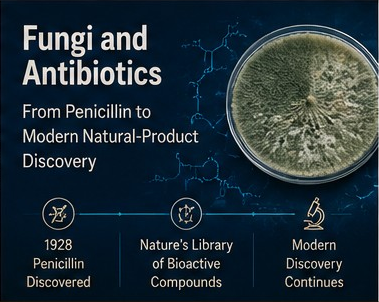
Alexander Fleming’s observation that a Penicillium mold inhibited nearby bacteria became the starting point for penicillin development. Turning that observation into a medicine required years of work: identifying active compounds, developing production strains, scaling fermentation, purifying the drug, testing safety, and building manufacturing capacity.
The lesson is not that mold itself is medicine. The lesson is that a natural observation can become a standardized therapy only through controlled development.
The Streptomyces correction
Streptomycin, tetracyclines, erythromycin-related compounds, and many other antibiotics trace to actinomycete bacteria such as Streptomyces. Older or poorly edited articles sometimes call these organisms fungi because their branching growth can look filamentous. Taxonomically, they are bacteria.
Keeping that distinction clear strengthens the fungal story rather than weakening it. Both bacterial and fungal natural products have transformed medicine, and each group requires its own biology and cultivation methods.
How researchers find new fungal compounds
Researchers collect or culture fungi, vary nutrients and environmental conditions, screen extracts against biological targets, separate mixtures, identify molecules with mass spectrometry and nuclear magnetic resonance, and test toxicity and mechanism. Genomic tools can reveal silent biosynthetic gene clusters that may encode compounds not produced under ordinary laboratory conditions.
The challenge is dereplication: quickly recognizing known compounds so effort can focus on genuinely new chemistry. Another challenge is selectivity—killing a pathogen without harming human cells or beneficial microbes.
Antibiotic resistance raises the stakes
Resistance evolves when microbes survive exposure and pass on protective traits. New compounds are needed, but discovery alone cannot solve resistance. Appropriate prescribing, infection prevention, diagnostics, manufacturing quality, agricultural stewardship, and global access all matter.
Fungal natural-product research is one part of a larger system. It should not be reduced to DIY antimicrobial remedies, which can delay treatment and increase risk.
What consumers should not do
Do not use mold, mushroom extracts, or unapproved products as replacements for prescribed antibiotics. Dietary supplements are not evaluated as antibiotics, and a laboratory finding does not establish a safe dose, purity, or clinical effect. Suspected infections require qualified medical evaluation.
Frequently asked questions
Did mushrooms create penicillin?
Penicillin was discovered from a Penicillium mold, which is a fungus. It was then developed into a standardized drug through extensive research and manufacturing.
Is Streptomyces a fungus?
No. Streptomyces is a genus of filamentous bacteria.
Do edible mushrooms act like prescription antibiotics?
No. Food or supplement use should not be equated with clinically approved antibiotic treatment.
Why are fungal genomes useful in drug discovery?
They can contain biosynthetic gene clusters that encode enzymes capable of producing complex natural products, including compounds not expressed under normal culture conditions.
Sources and further reading
Reviewed and organized by the MyShroom Planet™ Editorial Team. Product labels, formulas, and retailer listings can change, so use the current package directions for the exact product you purchase.